Roland, Lescure, French minister of economics, and finance introducing our discussion paper:
Europe is entering a new economic regime shaped by converging shocks.
Climate disruption, geopolitical tensions, trade fragmentation, and pressure on critical resources are no longer isolated risks — they are combining into a structural fragility that challenges the foundations of Europe’s growth model.
In this context, resilience, sustainability and sovereignty can no longer be treated as constraints or compliance topics. They must become core strategic principles — actively designed, engineered and scaled across industries and value chains. This is the central conviction of Ardabelle Capital: acting not merely as investors, but as architects of resilience.
To explore this transformation, we conducted deep dives across five key sectors — Food & Beverage, Luxury & Fashion, Beauty, Construction & Public Works, and Defense — and developed a macroeconomic model structured around four scenarios for Europe’s economy to 2050.
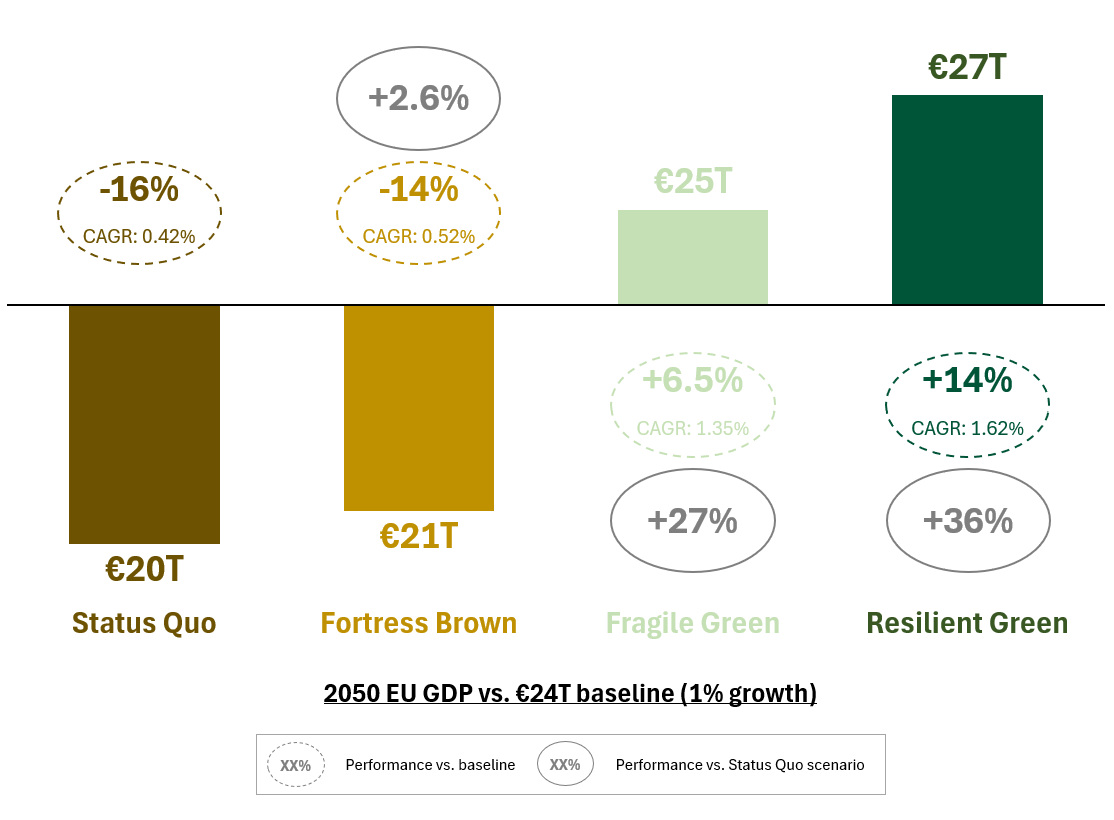
A central finding emerges: the conventional baseline, assuming stable growth of around 1.1% per year (leading to ~€24 trillion GDP by 2050), is no longer credible.
Climate impacts are not external shocks — they are becoming structural drivers of economic performance.
A more realistic reference point is the Status Quo scenario, in which delayed transition and fragmented responses lead to a structurally weaker economy of around €20 trillion by 2050, under a +2.4°C trajectory.
Alternative pathways diverge significantly. A Fortress Brown approach strengthens short-term resilience but fails to decarbonize, limiting long-term growth. A Fragile Green transition reduces emissions but lacks coordination, leaving economic potential underexploited.
Only the Resilient Green scenario — combining coordinated decarbonization with strategic resilience — delivers a step change, raising European GDP to around €27 trillion by 2050, 36% above the Status Quo trajectory.
The gap between inaction and coordinated transformation reaches €7 trillion by 2050, nearly twice the size of Germany’s economy today.
The implications are clear. The cost of inaction is structurally higher than the cost of transition. Partial or uncoordinated approaches are insufficient. And because climate,
energy and geopolitical risks interact multiplicatively, resilience must be designed systemically — across sectors, supply chains and institutions.
From an investment perspective, the case is compelling. Frontloading approximately €2.3 trillion between 2025 and 2030 can generate returns exceeding 200%, with each euro invested yielding more than three euros in economic value by 2050. Crucially, Europe can capture a significant share of these benefits even acting independently.
This is the role Ardabelle seeks to play: partnering with companies at the core of Europe’s industrial fabric to design, finance and scale resilient value chains.
Not as passive capital providers, but as long-term architects of transformation.
This report sets out a practical agenda for action — across corporates, financial institutions, policymakers and civil society — to reposition Europe’s economy around resilient, low-carbon systems, and unlock a new trajectory of sustainable growth.
20260330-SlidesGreeningArteries.pdf
20260330-Greening_Arteries.pdf