Summary of an op-ed by Virginie Morgon and Eric Hazan, founding partners of Ardabelle Capital, originally published in French in L'Opinion on 28 April 2026.
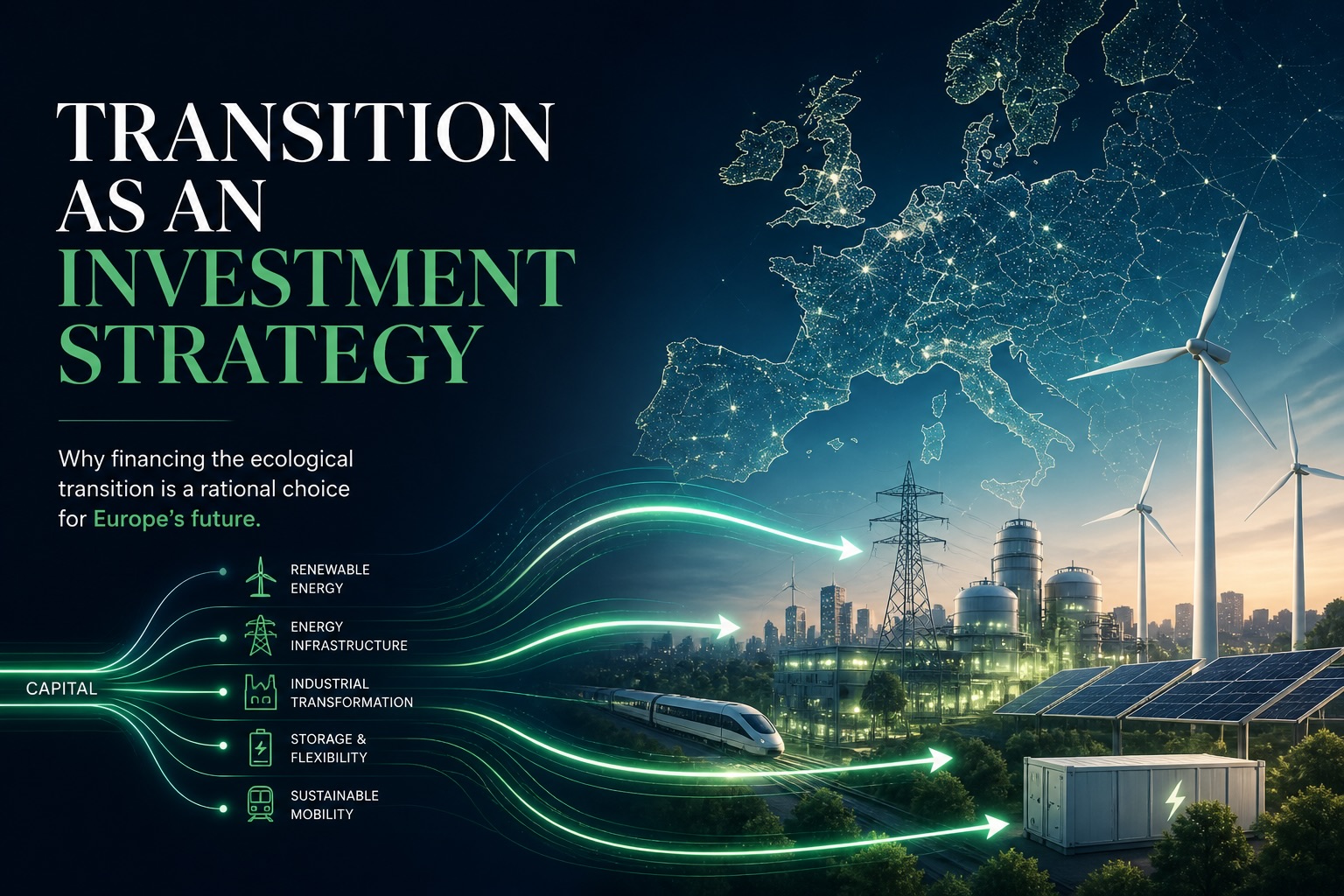
In their L'Opinion column, Virginie Morgon and Eric Hazan argue that European companies are quietly redefining how they think about the ecological transition. What used to be framed as a voluntary commitment or a regulatory burden is becoming a strategic imperative — driven less by rules than by economic reality.
In a world shaped by geopolitical instability, energy volatility and supply-chain fragmentation, decarbonising a business is a way to secure its foundations. It is not an ideological debate — it is a battle for resilience and competitiveness.
Key points
- A new economic regime. The war in Ukraine, Red Sea disruptions, aggressive U.S. trade policy and intensifying climate events have turned isolated shocks into structural fragility. Dependence has become an existential risk.
- A new benchmark for capital allocation. Comparing transition costs to a stable fossil scenario no longer makes sense. The relevant baseline is a chaotic fossil world — and against that backdrop, decarbonised assets carry a tangible "insurance value" that lowers exposure to external shocks.
- A €7 trillion gap. Ardabelle's Greening the Arteries of Europe's Economy study models a €7 trillion gap between inaction (€20T GDP by 2050) and a coordinated transition (€27T). Frontloading 2% of GDP per year between 2025 and 2030 generates a 218% modelled return — €3.18 for every euro invested.
- Beyond infrastructure: usage matters. Building renovation, eco-design, asset life extension, logistics optimisation and industrial sobriety often deliver the fastest, most tangible ROI — especially for mid-market companies.
- SMEs and mid-caps hold the keys. They make up 99% of Europe's economic fabric and up to 95% of large corporates' indirect emissions. Without adapted financing vehicles — blended finance, guarantees, resilience bonds — no decarbonisation strategy can scale.
- An indivisible triptych. Resilience, decarbonisation and sovereignty must be pursued together. Diversifying supply, relocalising critical segments, scaling the circular economy and industrialising Europe's 22% share of clean-tech patents form the only coherent path. > Europe is facing a €7 trillion bet. It is an economic choice, not a slogan. Either we invest now to build resilient value chains, or we accept structural decline.
Resilience, the authors conclude, has become the new competitiveness — and the case for action is one of economic lucidity, not idealism.
Virginie Morgon and Eric Hazan are founding partners of Ardabelle Capital.