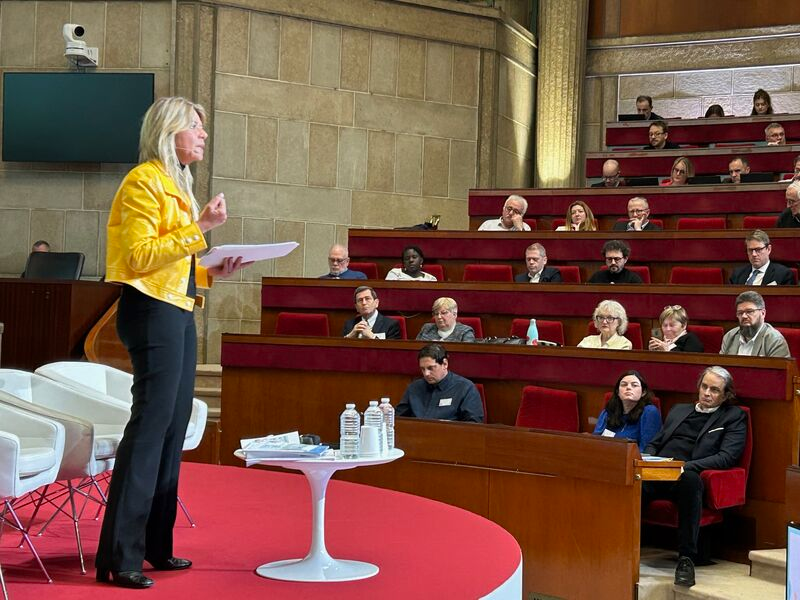
Virginie Morgon, Founder and Managing Partner of Ardabelle Capital, spoke at the Observatoire de la protection d'Aéma Groupe, hosted at the Conseil Économique, Social et Environnemental in Paris.
Europe is sitting on a paradox. Household savings have never been higher. Anxiety about the climate, industrial, and geopolitical transitions has never been more acute. And the continent's investment gap has never been more urgent. Yet these three realities remain largely disconnected.
Speaking at the CESE before the Observatoire de la protection d'Aéma Groupe, Virginie Morgon argued that bridging this disconnect is not optional — it is an existential pivot point for European competitiveness and resilience. Her remarks centred on three convictions.
Finance only has meaning when it finances the real economy
The first conviction is deceptively simple: capital must serve production. Investing in private markets — in unlisted companies — means directly financing businesses, innovation, decarbonisation, and the transformation of value chains. This is not an abstract claim. It is a description of what happens when equity reaches the companies that build, manufacture, and supply the goods and services the economy depends on.
At a time when public markets are increasingly driven by liquidity cycles and index mechanics, the case for private capital as a direct link between savings and the real economy is stronger than ever.
Savers have a decisive role to play in the great transitions
The second conviction targets a structural weakness: Europe's savings are massive, but poorly allocated and poorly understood. French household savings alone exceed €6 trillion. Yet the vast majority sits in low-yield, low-impact instruments — disconnected from the investment needs of the transition.
The remedy is not just better products. It is better information. Making finance intelligible — helping every saver understand that their money acts, and can change the world — is a prerequisite for mobilising capital at scale. Financial literacy is not a nice-to-have; it is infrastructure.
Financial actors must become accelerators, not accompanists
The third conviction is the sharpest. Sustainable finance, as practised by many, remains declarative — a layer of reporting and labelling that sits on top of business as usual. What is needed is transformational finance: capital allocation that actively reshapes industries, redirects supply chains, and demonstrates measurable impact.
This means moving beyond ESG compliance and towards a model where financial actors take responsibility for the direction and pace of change. Not as passive intermediaries, but as architects of transition.
An existential pivot
These three realities — abundant savings, urgent investment needs, and rising public concern — are waiting to be connected. Ardabelle Capital was founded on the conviction that this connection is both possible and necessary, and that investors today carry an immense responsibility to make it happen.
The window is open. The question is whether the financial industry will step through it.
Virginie Morgon — Speech at the CESE, Observatoire de la protection d'Aéma Groupe