From back office to front office
The CFO role in private equity has been quietly rewritten over the last decade. What used to be a back-office accounting function has become a front-office, strategic seat — closer to the CEO, closer to the LPs, and increasingly closer to the portfolio.
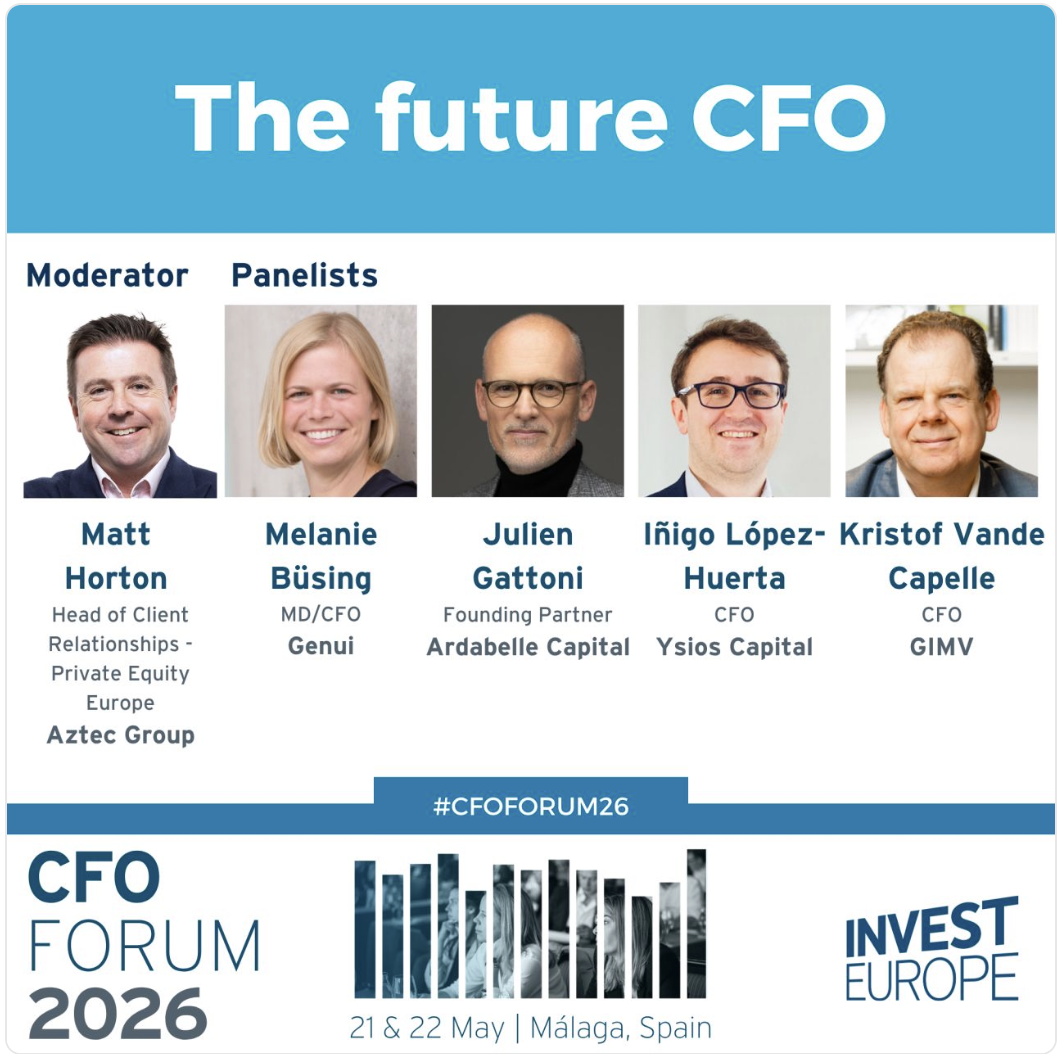
Modern CFOs are no longer just finance directors. They are orchestrators of projects and transformations, sparring partners to the CEO, and custodians of the data that bridges LPs, investment teams and GP functions. In the room in Malaga, the consensus was clear: this is one of the most exciting times to be a CFO in our industry.
AI: the new leverage
If there is one word that defined the panel, it is leverage — and today, AI is the new leverage for private equity.
- Capital calls that used to mean hand-editing fifty Word documents are now a single click.
- Bank reconciliation, statutory reporting, LP questionnaires — all moving from manual craft to supervised automation.
- Fund controllers are being asked to interact with and create agents, not just close the books.
For an emerging manager building from scratch, the opportunity is structural: starting on a modern stack is a fundamentally different baseline than retrofitting twenty-year-old systems. At Ardabelle, this is a deliberate choice — and an advantage we intend to compound.
What LPs are really asking
LP due diligence has shifted. Sustainability questions, once the dominant theme, now share the table with AI:
- How is AI being deployed at the GP level?
- How is it being deployed across the portfolio?
- Can you isolate the AI contribution in your value creation models and IC memos?
- How are you governing it as capabilities change week by week?
Major allocators are pushing these conversations across every portfolio company. For emerging managers, AI capability is now a standard line of inquiry, alongside the GP P&L, which has moved from a small chapter at the end of the deck to a core discussion topic.
Trust is still the product
For all the talk of automation, one thing did not move: the CFO is the grown-up in the room. The custodian of trust.
LPs need to trust that valuations are fair, that issues are reported transparently, and that the CFO knows exactly where the money is — even as the tools beneath us change every quarter. Fiduciary responsibility is not being automated away. If anything, automation raises the bar on judgment.
From portfolio reporting to value creation reporting
A recurring theme: reporting itself is being reinvented. Quantitative reporting — the part machines do well — is being industrialized. What remains, and matters more, is the qualitative layer: what is working, what is not, and what the investment team actually thinks.
The CFO's job is to animate that reporting — to keep the cadence, ensure it lands operationally, and identify the pain points where AI and process change can unlock the next layer of value.
DPI over IRR
The panel also touched on a quieter shift in how performance is measured. DPI is becoming the metric that matters — LPs want to know when the next distribution lands, not just what the paper IRR looks like. Exits remain harder than they were 18 months ago, and several firms are explicitly choosing to hold their best companies longer through anchor strategies, rather than being purely exit-driven.
What this means for Ardabelle
Building Ardabelle as a new manager, we sit on the right side of most of these trends:
- A modern, AI-native operating stack from day one.
- A CFO/COO function designed as a strategic seat, not a back office.
- A reporting philosophy oriented around value creation, not just compliance.
- A direct, trust-based dialogue with LPs — fewer questionnaires, more substance.
The Future CFO is not a job description. It is a posture: technical enough to build the leverage, senior enough to carry the trust, and curious enough to keep rewriting the playbook.
Julien Gattoni is Founding Partner and CFO/COO of Ardabelle Capital. He spoke on the closing "Future CFO" panel at the CFO Forum 2026 in Malaga.