Summary of an article by Esther Attias, originally published in French in La Tribune on 27 May 2026, covering Ardabelle Capital's Greening the Arteries of Europe's Economy study.
In La Tribune, finance journalist Esther Attias takes a hard look at the numbers behind Ardabelle Capital's macroeconomic study and frames a single, stark question for European decision-makers: what is the price of doing nothing?
The answer, drawn from our modelling across Food & Beverage, Luxury & Fashion, Beauty, Construction & Public Works, and Defense, is €7 trillion — nearly twice the size of Germany's economy today.
Climate impacts are no longer external shocks. They are becoming structural drivers of European economic performance — and the cost of inaction is now measurable, large, and compounding.
Key points from the article
- Inaction has a price tag. Under a Status Quo trajectory of delayed transition and fragmented responses, European GDP plateaus at around €20 trillion by 2050, under a +2.4°C pathway. A coordinated Resilient Green trajectory lifts that figure to €27 trillion — a 36% uplift.
- A €7 trillion gap. The difference between these two scenarios is not a rounding error. It is a generational competitiveness gap, driven by compounding climate damages, supply-chain disruption, and strategic dependencies.
- Frontloading pays. Investing roughly 2% of GDP per year between 2025 and 2030 — about €2.3 trillion in cumulative capital — generates a 218% modelled return. Every euro invested yields €3.18 in economic value by 2050, of which €2.50 comes from avoided climate damages alone.
- Resilience is the new competitiveness. In a world shaped by geopolitical instability, trade fragmentation, and energy volatility, decarbonised assets carry a tangible insurance value. The relevant baseline is no longer a stable fossil world — it is a chaotic one.
- Mid-market is where transformation happens. SMEs and mid-caps make up 99% of Europe's economic fabric and up to 95% of large corporates' indirect emissions. Scaling the transition means equipping them with the right capital, tools, and partners. > Either Europe invests now to engineer resilient, low-carbon value chains — or it accepts structural decline. There is no neutral path.
Ardabelle's role
This is the conviction at the core of Ardabelle Capital's strategy: acting not as passive capital providers, but as long-term architects of resilience — partnering with mid-market companies at the heart of Europe's industrial fabric to design, finance, and scale the value chains the continent will need.
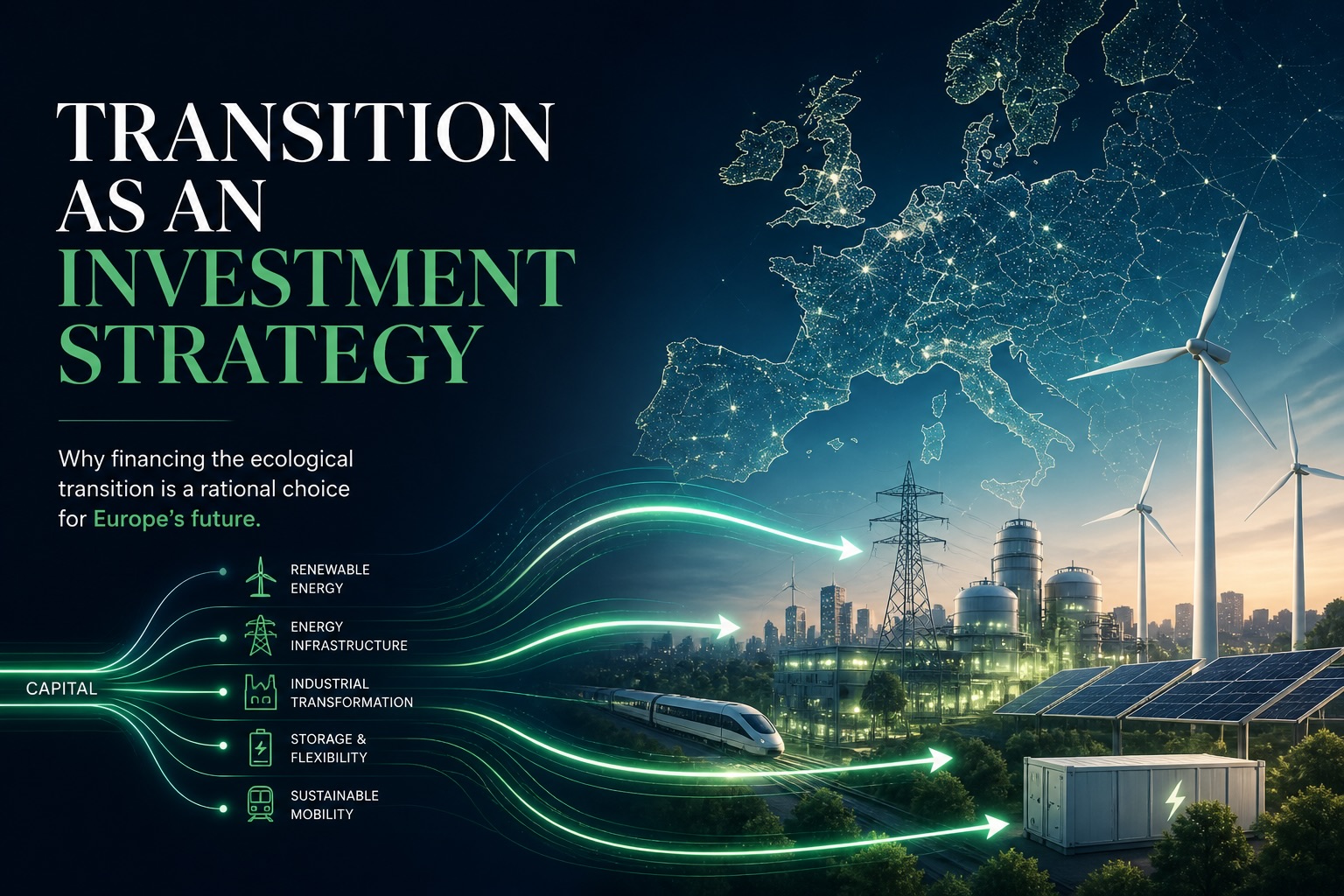
The La Tribune coverage extends a broader conversation already underway in L'Opinion, at the Conseil Économique, Social et Environnemental, and across European policy circles: decarbonisation is not an ideology, nor a compliance burden. It is, increasingly, the most rational investment strategy available to European capital.
La Tribune — 7 000 milliards d'euros, le prix astronomique de l'inaction climatique pour l'Europe, selon le fonds Ardabelle
Greening the arteries of Europe’s economy